

Home EV Charging

If you drive an electric vehicle — or are planning to — a dedicated home charger is one of the most practical upgrades you can make. It's lower in cost and complexity than most retrofit measures, but the difference it makes to day-to-day EV ownership is significant.
Why Not Just Use a Standard Plug?
A standard 3-pin household socket will charge an EV, but slowly — typically adding around 8–10 miles of range per hour. For most drivers, that's workable in an emergency but inadequate as a daily solution.
A dedicated 7 kW home charger delivers roughly 25–30 miles of range per hour. For the majority of EVs, that means a full charge overnight from near-empty — without having to think about it.
Smart Charging — What It Actually Means
Most modern home chargers are "smart" chargers, and it's worth understanding what that means in practice.
A smart charger connects to your home Wi-Fi and can be scheduled, monitored, and controlled via an app. This matters for two reasons:
Off-peak tariffs — Electricity is significantly cheaper overnight on time-of-use tariffs such as Octopus Go (sometimes as low as 7p per unit). A smart charger can be set to start automatically during cheap rate hours, meaning you're routinely charging at a fraction of the standard unit rate. Over a year, the savings are substantial.
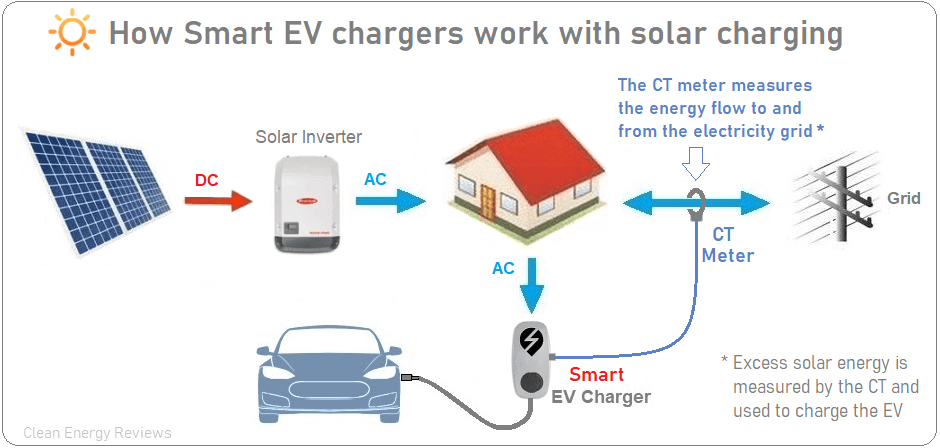
Solar PV integration — If you have solar panels, a compatible smart charger can be configured to divert surplus generation directly to your car during the day. Rather than exporting cheap solar electricity to the grid, you're using it to charge your vehicle for free. This works particularly well for anyone who works from home or has a vehicle parked during daylight hours.

Image from ev.energy
What the Installation Involves
Installation is typically completed in a few hours by a single engineer. The charger unit is wall-mounted — on an external wall, in a garage, or on a carport — with a cable run back to your consumer unit.
As part of the installation, your electrical supply should be assessed. Most modern properties handle a 7 kW charger without issue, but older consumer units, existing load on the supply, or properties with a single-phase supply near its limit may require some electrical work first. A competent installer will identify this upfront.
Charger units are weatherproof and designed for permanent outdoor installation. Most include a tethered cable (fixed to the unit) or a socketed outlet for use with your own cable — personal preference and vehicle type will determine which suits you better.
Costs
Typical installed cost is £800–£1,200, making this one of the more accessible retrofit measures. There is currently no government grant available for most homeowners (the previous OZEV grant was discontinued for home installations in 2022, though grants remain available for renters and flat owners in some circumstances — check gov.uk for current eligibility).
Your installer must be OZEV-approved (Office for Zero Emission Vehicles). This was a condition of the previous grant scheme but remains the relevant quality standard for home charger installation. Always verify approval before proceeding.
Pairing With Solar PV and Battery Storage
A home charger, solar PV, and battery storage form a genuinely powerful combination. In simple terms:
Solar generates during the day
Battery stores what isn't immediately used
Car charges from battery or direct solar, and top-ups overnight on a cheap tariff
The degree to which this stacks up financially depends on your driving patterns, solar array size, and battery capacity — but for households with all three, grid electricity costs for transport can be reduced dramatically.
Key Takeaway
A home EV charger is a straightforward, relatively low-cost installation that transforms the practicality of EV ownership. Paired with solar PV or a smart tariff — ideally both — it also becomes a genuine energy management tool, not just a convenient socket.